Multi-task learning
Shared structure becomes cheaper than solving every task with an isolated shortcut.
A theory of when “prediction” becomes “understanding”, and how simplicity can reveal the hidden variables behind observations.
Department of Automation, Tsinghua University
Outstanding Paper Award · ICLR 2025 Workshop on World Models
Does a model understand the world—or merely fit the data?
Many internal representations can explain the same training data. We therefore define world-model learning as a problem of representation identifiability and derive conditions under which neural networks recover the variables that actually generated their observations.
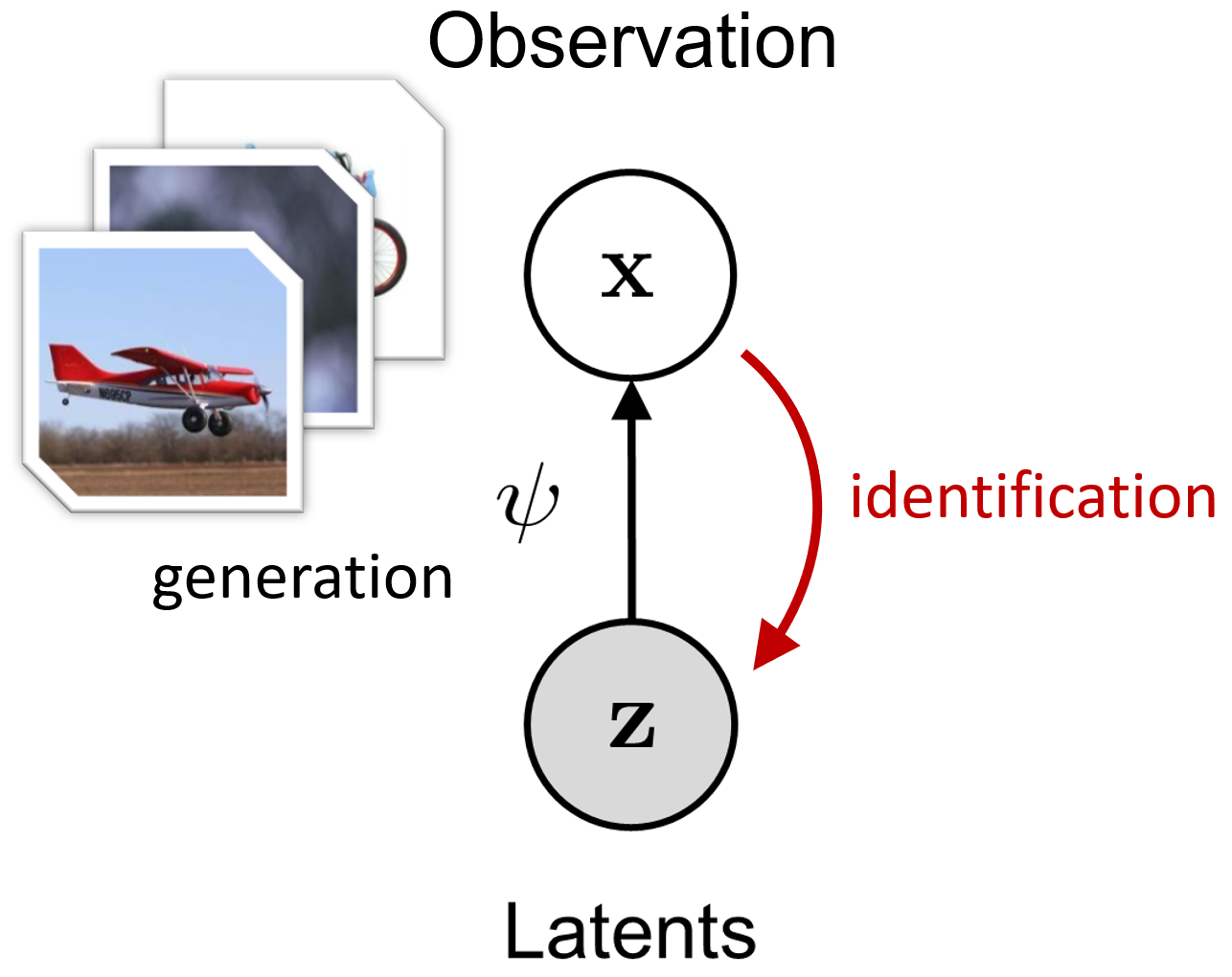
Latent variables are rendered into observations through an invertible generation function . A representation learns a world model when it recovers up to a simple invertible transformation .
A world model is an inverse of reality.
Without structural assumptions, latent variables are not identifiable: multiple incompatible worlds can generate exactly the same observations. Rather than imposing a narrowly specified data model, we ask whether the learner's own inductive bias can remove this ambiguity.
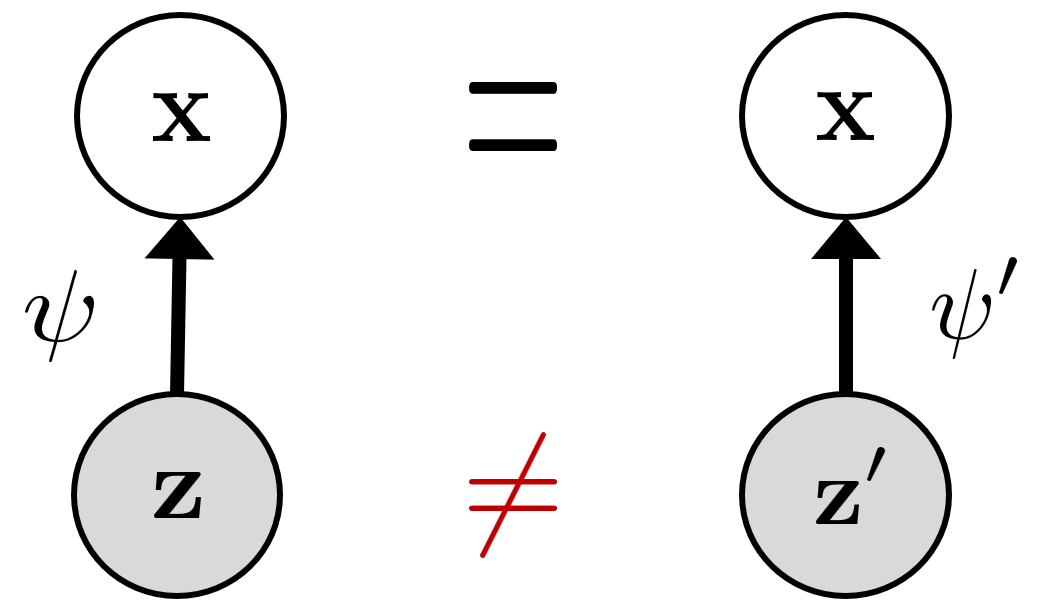
Identifiability emerges from an interaction between how the model learns, how many tasks it sees, and which tasks the world presents.
Shared structure becomes cheaper than solving every task with an isolated shortcut.
A low-degree preference filters out plausible but unnecessarily complex latent worlds.
Real tasks slightly favor low-degree functions of the true latent variables.
The lowest-complexity representation recovers the true latent variables up to permutation and sign flips—simple transformations that preserve the structure of the world.
A flat predictor is always the simplest realization.
A common representation amortizes complexity across tasks.
Every information-preserving representation is equally good.
The true latents become the simplest shared solution.
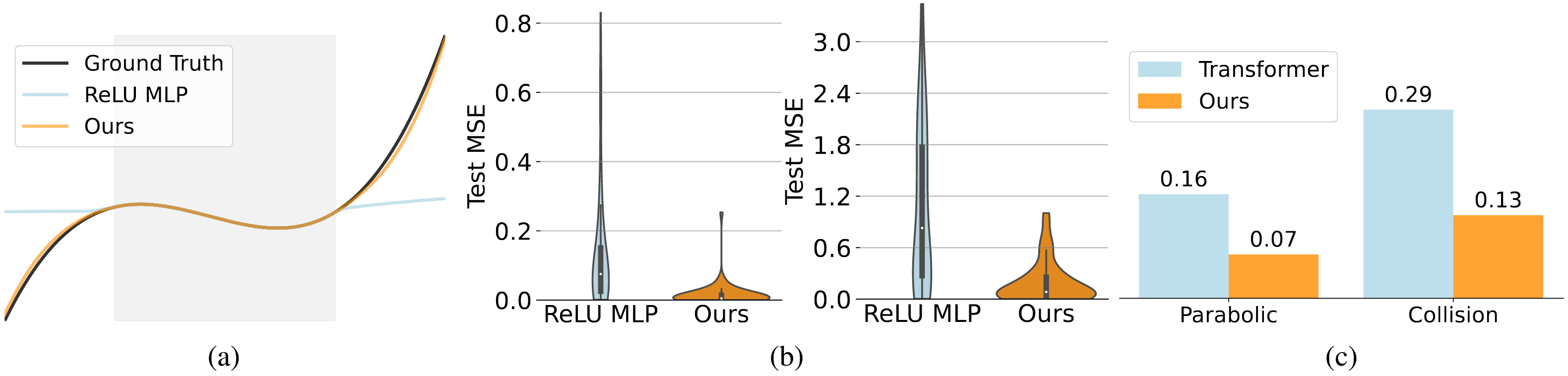
Architecture determines which functions feel simple. Guided by the theory, we modify standard MLP and Transformer blocks so the target low-degree structure is easier to represent.
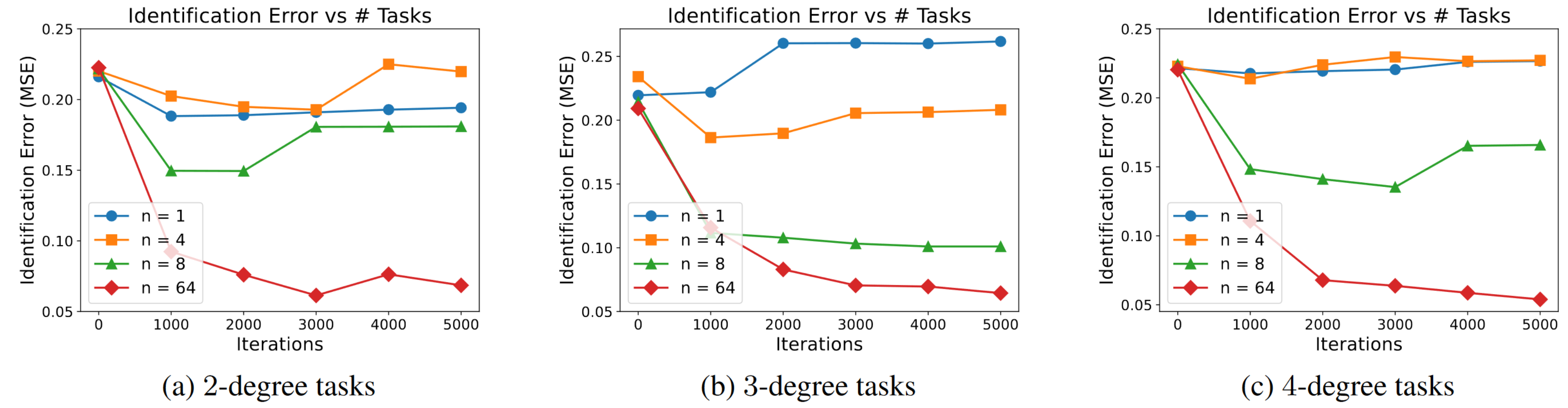
Proof-of-concept experiments track identification error as the number and degree of tasks change. The empirical phase transition mirrors the theory: enough appropriately distributed tasks drive recovery error toward zero.
@inproceedings{zhang2025world,
  title     = {When Do Neural Networks Learn World Models?},
  author    = {Zhang, Tianren and Chen, Guanyu and Chen, Feng},
  booktitle = {International Conference on Machine Learning},
  year      = {2025}
}